
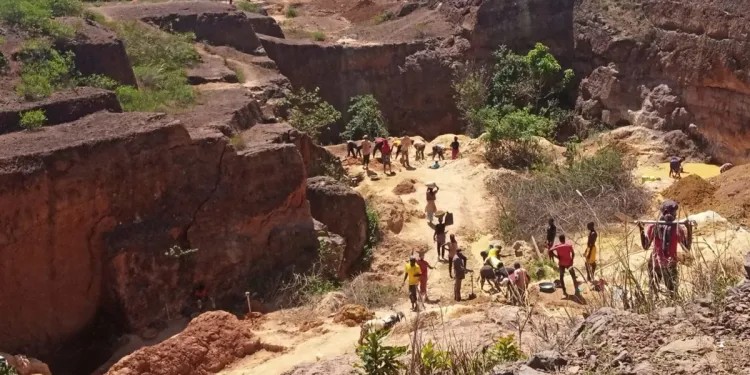
Mr Olatunji noted that the current financing model in the sector is not sustainable.
by Mary Izuaka
Poor access to finance has been identified as a major hindrance to the growth and development of the Nigerian mining sector, according to the President of the Nigerian Mining and Geosciences Society (NMGS), Akinade Olatunji.
Mr Olatunji, in an interview with PREMIUM TIMES, noted that the current financing model in the sector is not sustainable.
“Because we don’t have a mining ecosystem that is mature, it’s difficult for people to get finance. So, financing the sector has been more of ad-hoc, family kind of borrowing and all that stuff, and that’s not sustainable. You can also not run mining activity with a kind of two-digit interest rate we run Nigeria. Nobody does that anywhere in the world,” Mr Olatunji said.
He explained that the investment to run exploration work is usually within the first 5 per cent interest rate.
“Sometimes even less than that, because they see it as a long-term investment, but there’s no Nigerian bank that will give you that kind of loan. We all know what Nigerian banks are interested in, and it’s because of lack of knowledge, even on their own part. So, financing has been very problematic,” he said.
To address this, he said private sector driven funding is the way forward.
“But seriously speaking, the kind of finances that is needed for the mining sector should be private sector driven, should be private funds. And that’s why I like the idea by the minister who says that Nigerian mining companies should also begin to look at the opportunity of creating their own banks. It’s not impossible. If two to five mining companies who have done very well pull resources together and say, let’s all set up a mining development bank. It will be easier for them because they understand the intricacies of the sector. It won’t be like the kind of banks we have now. Nigerian banks now, 90 per cent of them just want to do container imports, import financing. That will never work in the mining sector. So, finance is key,” he added.
Mr Olatunji said despite being richly endowed with mineral resources, Nigeria’s mining sector lacks significant investment.
“When we talk about mineral resources, we know that Nigeria is blessed. We are rich. Despite these mineral resources, it’s really so sad that we don’t have that huge investment in the sector. When I say investment, in terms of having large mining activities going on. The closest we have is the Segilola, which is this gold,” he said.
Speaking on the role geologists play in the sector, he said the experts are very key to finding where the minerals are.
But to find the minerals, he said there is a need for a structured approach.
“A structured approach to do this could be geophysical, geochemical, whatever. But you must have a structured exploration approach to finding where the minerals are. Not only finding where the minerals are, finding the quantity and quality of the minerals. Because it’s not all mineral occurrences that are profitable to win. So, before you get to a level whereby mineral occurrence becomes a resource for you to mine, a lot of investigation is involved. And this is the work that geologists do.”
He added that the NMGS is the umbrella professional society for all geoscientists, noting that the society was founded 15 January 1961 by ten individuals.
“Seven of them were mining engineers, two metallurgists, and one geologist. And over the years, the society has been involved in policy advocacy, policy support, and of course in molding opinion in the geoscience and mining profession,” he said.

 madaraka.online