

EXECUTIVE SUMMARY –
Liberia aims to unlock over USD 3 billion in revenue from its mining and energy sector through a 2025–2029 strategic plan focused on governance reforms, decentralization, legal modernization, better data, and a shift from royalties to equity participation. The plan targets curbing illegal mining, strengthening institutions, digitizing services, and expanding artisanal formalization, with a USD 39.5 million investment intended to turn natural resources into tangible development gains.
Keywords: Liberia, mining and energy, strategic plan 2025–2029, revenue mobilization, governance reform, equity participation, decentralization, illegal mining, artisanal mining, digitization, legal modernization, resource development
Liberian Observer (Monrovia) By Emery Watson
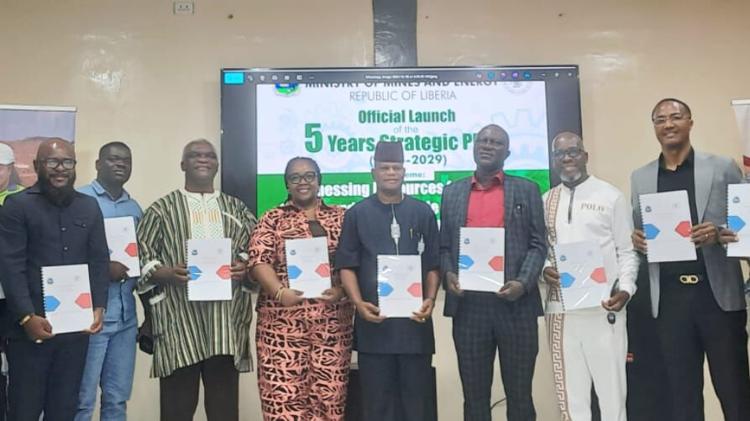
The Government of Liberia says it is positioning the mining and energy sector to generate more than US$3 billion in revenue, following the rollout of the Ministry of Mines and Energy’s (MME) Five-Year Strategic Plan for 2025-2029, a policy document aimed at modernizing the sector and transforming it into a major pillar of national economic growth.
The strategic plan was officially launched at a high-level ceremony attended by senior government officials, Members of the National Legislature, development partners, and representatives of Liberia’s extractive industries.
The document outlines reforms intended to strengthen governance, expand domestic revenue, improve transparency, and ensure that Liberia’s natural resources deliver meaningful benefits to citizens.
Speaking at the launch, Minister of Mines and Energy, R. Matenokay Tingban, acknowledged that while strategic planning is essential, effective implementation will determine whether the sector achieves its full potential.
“Planning is important, but the challenge of implementing scrupulously will always be the biggest hurdle we must overcome,” Minister Tingban said. “The mines and energy sector can contribute significantly to our national budget to appreciable levels beyond three billion dollars if we invest in areas where returns will be highest.”
Minister Tingban emphasized that Liberia must move beyond a narrow focus on royalties and instead pursue equity participation in extractive ventures.
He noted that strengthening national capacity to explore, research, and develop credible geological data will be critical to attracting responsible investment and maximizing returns.
“The future must see Liberia growing from royalty collection to equity participation,” he said, adding that enhanced data generation and institutional capacity will be central to that transition.
Delivering remarks at the event, Liberia Revenue Authority Commissioner General, Dorbor Jallah, described the mining and energy sector as strategically vital to Liberia’s fiscal sustainability, noting that it remains one of the most dependable sources of domestic revenue.
“Every dollar invested in this sector returns many more to the government,” Jallah said. He stressed that achieving revenue growth will depend on efficient licensing systems, sound policy frameworks, and reliable production data.
Jallah commended the Ministry of Mines and Energy for developing what he called a clear and forward-looking roadmap and reaffirmed the LRA’s commitment to closer collaboration with the Ministry through data sharing, digital integration, contract compliance, and coordinated oversight across the extractive value chain.
According to the LRA Commissioner General, the ultimate measure of the strategy’s success will be Liberia’s ability to convert natural resource wealth into tangible benefits for its people.
“The success of this plan will be judged by how well we transform our resources into real development outcomes,” he said.
Also speaking at the ceremony, Jeremiah G. Sokan, Chair of the House Committee on Mines, Energy and Natural Resources and Representative of District #1, Grand Gedeh County, described the plan as pragmatic, realistic, and measurable.
He warned that illegal and unregulated mining continues to threaten national revenue and deprive local communities of benefits, particularly in border and resource-rich counties.
“Our natural resources are being depleted, even while communities barely feel the impact or benefits at a national level,” Sokan said.
He called for stronger regulation, improved inter-agency coordination, and greater community participation to curb illegal mining and ensure sustainable resource management.
Minister Tingban outlined several priority reform areas under the strategy, including decentralization of mining and energy services across all 15 counties, modernization of outdated mining and energy laws, formalization of artisanal and small-scale mining, and the upgrading of geological and hydrological data systems.
As part of the decentralization drive, the Ministry has already opened its first county office in Bentol, with plans to establish fully functional offices nationwide.
To support this initiative, 30 mining engineers and geologists have been recruited to serve as county mining officers and resident geologists, ensuring technical coverage across the country.
The Ministry disclosed that the first group of newly recruited professionals is expected to travel to India in early 2026 for Health, Safety, and Inspection training.
In addition to renting office spaces, the Ministry plans to construct five Ministry-owned facilities in five counties by 2029.
On the legal front, the Ministry is reviewing a Mining Law that is more than 25 years old, as well as mineral policies that date back over 15 years.
The revised Mining Law has already been submitted to the Office of the President, while more than six mining regulations have been finalized and are currently operational.
Modernization of geological and hydrological data also features prominently in the strategy.
Much of Liberia’s existing data dates back to 1972, prompting the Ministry to engage bilateral and multilateral partners, including China, the United States Geological Survey, and the French Government, with the aim of comprehensively updating national geoscientific information by 2029.
Formalization of artisanal and small-scale mining is another major focus. At present, only about 500 miners are licensed nationwide.
The Ministry aims to increase that number to at least 1,000 licensed miners by 2029 and establish 15 artisanal and small-scale mining cooperatives. This effort will be supported by an estimated US$1.34 million investment from the African Development Bank.
Institutional strengthening and accountability also form a core part of the plan. The Ministry intends to digitize at least 80 percent of its operations by 2029, up from the current level of approximately 40 percent.
An online licensing system developed in partnership with the LRA has already been rolled out, allowing for online applications and payments, including through mobile money.
Inter-agency collaboration has been strengthened with institutions such as the LRA, Environmental Protection Agency, Forestry Development Authority, and the Ministry of Internal Affairs to enhance data sharing, monitoring, and oversight, with the goal of improving governance and preventing revenue loss.
Minister Tingban further highlighted the need for greater national participation in the mining industry.
Although Liberia holds equity in some concessions, no institution currently exists to manage those equity interests. The Ministry plans to establish a dedicated entity to manage government equity holdings, safeguard dividends, and promote job creation for Liberians.
The total budget required to implement the Five-Year Strategic Plan is estimated at US$39.5 million. While modest compared to the sector’s revenue potential, the Ministry believes the investment is strategic enough to deliver early gains and allow for gradual scaling.
Aligned with the Government’s ARREST Agenda for Inclusive Development and President Joseph Nyuma Boakai’s vision of “Think Liberia, Love Liberia, and Build Liberia,” the rollout of the strategy has generated optimism that Liberia’s mining and energy sector can finally fulfill its promise as a driver of sustainable national development.
SOURCE:

 madaraka.online