

EXECUTIVE SUMMARY –
At the South Africa Exploration Investment Forum alongside the Investing in Africa Mining Indaba, Deputy Minister Phumzile Mgcina said South Africa has significant untapped mineral potential, supported by new exploration projects funded through the Junior Mining Exploration Fund and research by the Council for Geoscience. She highlighted more than R2 billion in investment commitments, active and planned drilling projects targeting minerals including rare earths and lithium, and the launch of the Virtual Core Library to digitise geological data and strengthen the country’s exploration competitiveness.
Keywords: South Africa, Phumzile Mgcina, Investing in Africa Mining Indaba, Council for Geoscience, Junior Mining Exploration Fund, mineral exploration, rare earth elements, lithium, mining investment, Virtual Core Library
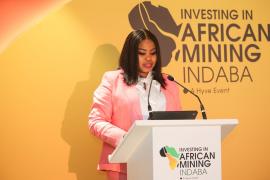
Deputy Minister of Mineral and Petroleum Resources Phumzile Mgcina has reiterated government’s stance that South Africa’s mining industry is on the rise.
The Deputy Minister addressed the South Africa Exploration Investment Forum, held on the sidelines of the ongoing Investing in Africa Mining Indaba, in Cape Town.
“The Council for Geoscience (CGS) is our implementing entity – mandated to quantify the inherent value of South Africa’s mineral wealth across a range of strategic mineral commodities. This work is already pointing to significant untapped mineral potential, thus reinforcing our message that South African mining is a sunrise industry.
“That is not being theoretical but realistic. This is being demonstrated through the success of projects supported under the Junior Mining Exploration Fund (JMEF),” she said.
The JMEF forms part of South Africa’s mineral exploration strategy aimed at, among others, attracting exploration investment, reigniting mineral development and accelerating new mineral discoveries.
The first window of applications saw some R160 million allocated to eligible applicants, while the second window has attracted 80 applications.
“One such project in Bothaville, Free State, has advanced into an intensive drilling phase targeting rare earth elements and associated minerals. In addition, two projects in the Northern Cape are scheduled to commence drilling this year, while at least four other projects are in the early stages of mapping, and acquiring geophysical and geochemical datasets.
“Together, these projects confirm that South Africa’s subsurface potential is, indeed, far from fully understood and realised,” she asserted.
The fund has also received encouraging responses, with commitments reaching billions of rands.
“Commitments have grown to over R2 billion, marking a significant increase from the initial R400 million contributed by the department and the Industrial Development Corporation.
“Equally encouraging is the level of interest of the people, with the second round attracting 80 applications targeting a diverse range of minerals, including Tin, Tungsten, Titanium, Uranium, Gold, Antimony, Arsenic, Fluorspar, Copper, and Lithium.
“Notwithstanding this progress, we continue to urge industry partners and investors to partner with us by investing in exploration as the lifeblood of a sustainable mining sector,” Mgcina said.
The Deputy Minister noted that the CGS launched the Virtual Core Library.
She described the library as a “strategic national asset designed to transform how South Africa extracts value from its geological assets”.
“This initiative is poised to advance our mining industry into an era of digital transformation. By enabling the digital preservation and analysis of historical drill core, the library will fast-track exploration decision-making, reduce costs, and enhance South Africa’s competitiveness as an exploration destination.
“The platform further promises lower barriers to entry for junior and emerging explorers, as well as revitalise interest in underexplored regions. Most importantly, it safeguards our geological heritage while stimulating new exploration activity,” Mgcina said
SOURCE: https://www.sanews.gov.za/south-africa/sa-untapped-mineral-potential-still-significant
See also: MADARAKA: The Poor Shall Inherit the Earth, Including Its Natural Resources

 madaraka.online