
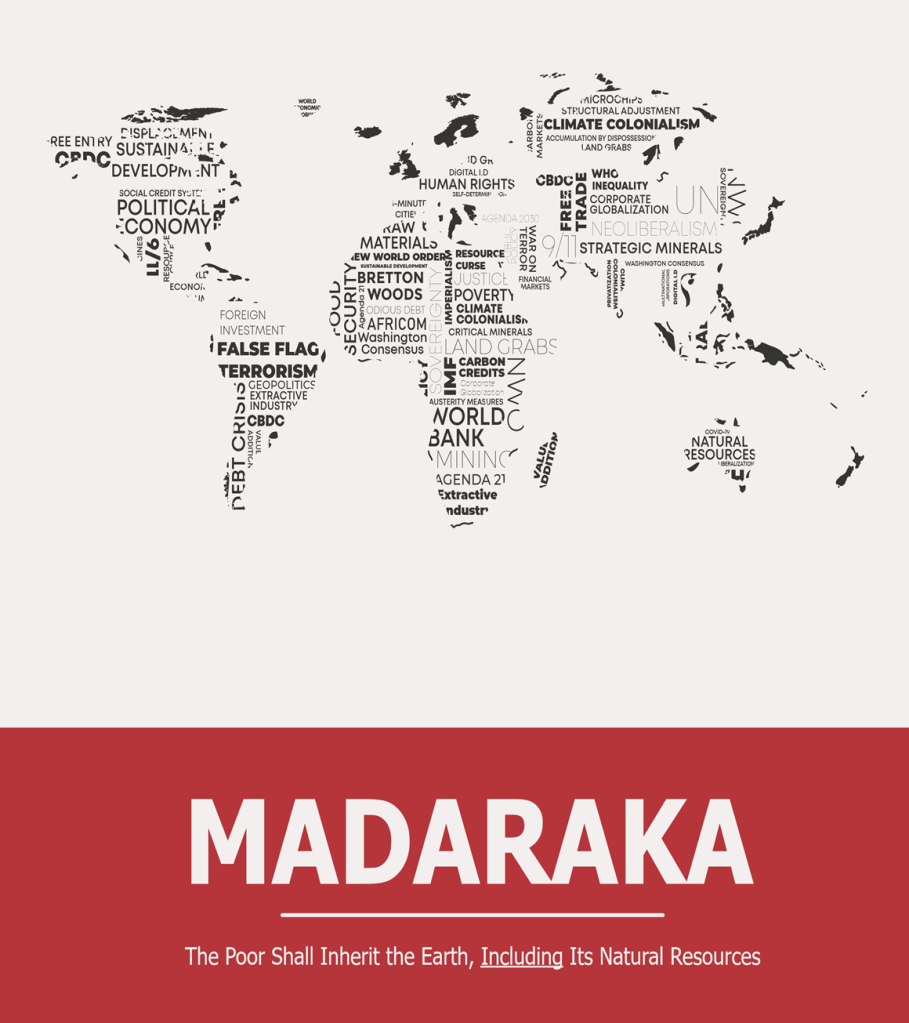
Cover: Copyright © 2026 Wanyee Kinuthia
SUMMARY
Madaraka is the Swahili word for self-determination. Article 2 of the United Nations 1960 Declaration on the Granting of Independence to Colonial Countries and Peoples states: “all peoples have the right to self-determination; by virtue of that right they freely determine their political status and freely pursue their economic, social and cultural development.”
However, the conditions of economic development and democracy have been profoundly and adversely altered by corporate globalization. This is most evident in Africa’s extractive sector, which is marked by the exploitation of both people and the environment, exclusively for the pursuit of profit for a few.
This book provides a compelling examination of corporate-driven resource extraction on the African continent, with a specific focus on Kenya. The book meticulously reveals that the socioeconomic and environmental challenges posed by the extractive sector are not isolated incidents but part of a larger, systemic problem. This is underscored by the complex interplay between political economy, corporate globalization, sustainable development, public policy, human rights and the rule of law.
The book concludes by sharing insights on the process of industrializing Africa and enjoining the call for a world order in which the continent is no longer exporting unprocessed raw materials, but is the centre of global manufacturing, adding value to its own natural resources.
The African experience further reveals how resource-rich nations often suffer from the “resource curse” and how this is mostly driven by the need to repay illegitimate or “odious debts”. The concept of odious debt is an established legal principle that is used to refer to debts owed even though the borrowed funds have been misappropriated by state officials and were either used for personal purposes or oppressing the population. Debts can also be considered odious if the creditors were aware of the likely misappropriation of the funds they were advancing. African nations must therefore reject these odious debts as a necessary step towards achieving true independence and self-determination.
Madaraka is a crucial resource for anyone seeking to understand the multifaceted challenges of the corporate extractive industry in Africa. It is an essential read for those fighting against systemic resource plunder and injustices on the continent and for those striving for a sustainable, equitable and prosperous future for Africa’s new generations.
About the Author
Wanyee holds a Master’s degree in Globalization and International Development from the University of Ottawa, Canada. His extensive work with mining-affected communities in Canada provides him with a unique and critical perspective on the global extractive industry, particularly because Canada is home to about half of the world’s publicly listed mining and mineral exploration companies. His MA thesis has been cited in a number of journal articles and research papers, and is hosted on the repository of Library and Archives, Canada. He is also a Founding Director of the Kenyan Chapter of the African Sovereignty Coalition.
Order the book on Amazon
 madaraka.online